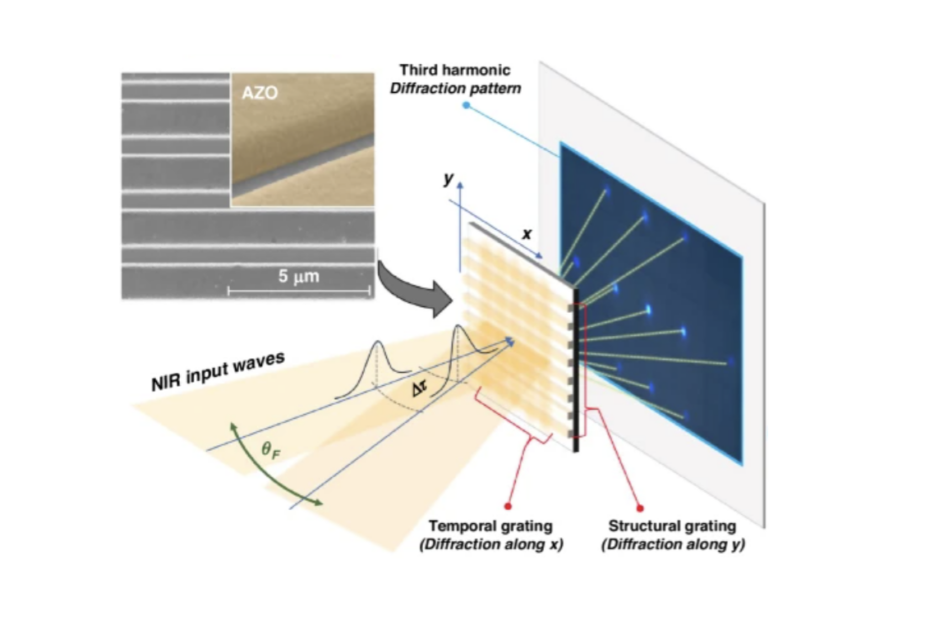
In this paper, in a collaboration led by Prof. M. Ferrera’s group, we show that a diffraction grating does not need to be fabricated: it can also be written with light, for a fraction of a picosecond. When light meets a periodic structure with a period close to its wavelength, it diffracts, and this principle underpins everything from spectrometers to X-ray crystallography. Here we ask when the diffracting object exists, as well as where, and treat time as a design parameter. We combine a physically patterned grating with an orthogonal transient grating, created by interfering two ultrafast pulses in a highly nonlinear transparent conducting film operated in its low-index regime. Together they form a two-dimensional spatio-temporal metalattice, which we probe through the film’s own third-harmonic signal or with an external probe beam. The light-induced lattice diffracts about as efficiently as its fabricated equivalent. It can also be reconfigured on demand by changing the pulse delay, angle of incidence or wavelength, and shaped further with a phase mask. This approach moves device design from fixed fabrication constraints to engineering the light itself, opening new routes to ultrafast transient lithography and reconfigurable photonics.